
S4 RND 5: When Life Gives You Le Mans…
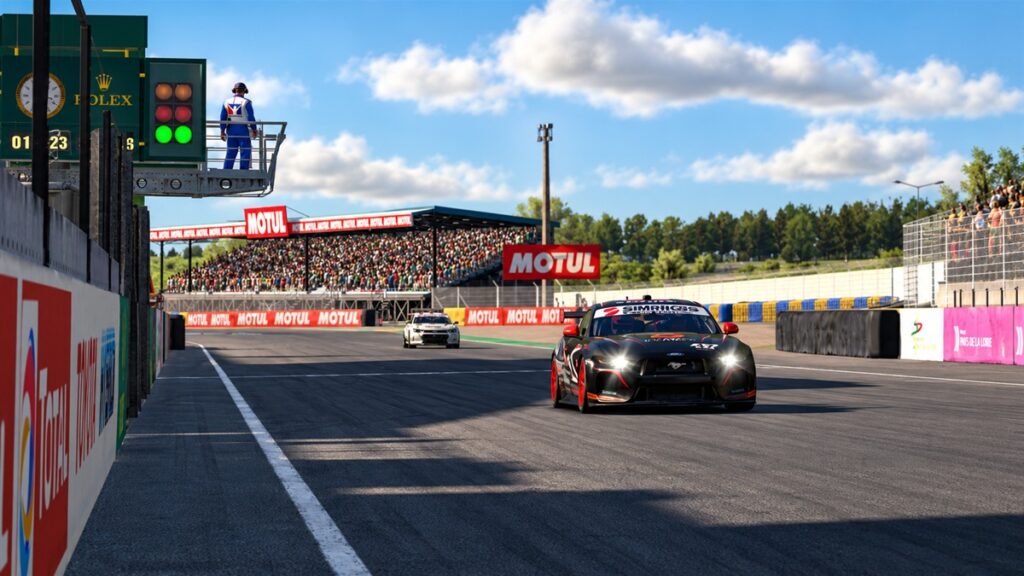
V8 Vets | Season 29 | Round 5 | Split 4
Long straights, legendary corners, enormous braking zones and enough opportunities to make a very expensive mistake before you’ve even finished the opening lap.
For Split 4 of the V8 Veterans, fifteen laps around the famous French circuit delivered a little bit of everything. A fiercely competitive battle at the front, an opening lap that left several drivers wondering what had just happened, some terrific drives through the field and a championship lead decided by a single point.
And judging by the amount of attention the blue barriers received through the Porsche Curves, a few drivers were apparently determined to leave their signatures on the place.
Experience counts, but nothing comes easily
Mark Dyall knows his way around Le Mans. Having raced everything from GT3 machinery to VW Jettas at the circuit, including several 24-hour events, he’s spent considerably more time circulating the famous French venue than most people would consider entirely reasonable.
And that experience was about to come in handy.
Qualifying gave an early indication of just how competitive the evening might become. Gordon Smith secured pole with a 4:02.835, while Dyall and Marty Hansen lined up second and third, separated by an almost ridiculous 0.003 seconds. Michael Hayes claimed fourth, with championship leader Sean Taylor fifth and Michael Koroleff sixth.
There was very little between the leading contenders, and fifteen laps of Le Mans offered plenty of opportunities for that order to change.
Dyall ultimately emerged with his second victory of Season 29, leading ten laps, setting the fastest race lap of 4:03.261 and beating Hansen home by 2.443 seconds. Smith completed the podium, with Koroleff fourth and Hayes fifth.
But behind those tidy numbers was a race that required more than simply putting together quick laps.
“It was kind of controlled,” Dyall said of his evening, although even the eventual winner found himself adjusting his strategy. He pitted a lap earlier than originally planned, while Hansen and Koroleff stopped a lap later.
With two compulsory stops squeezed into just fifteen laps, there wasn’t much room to get the calculations wrong. A poorly timed stop, an unnecessary slowdown or a little too much time in pit lane could quickly undo several laps of hard work.
Dyall identified avoiding slowdowns as one of his biggest challenges, particularly with Hansen, Koroleff and Smith all in contention. He also recalled taking advantage of Hansen locking a wheel at Turn 4 to make a pass, another reminder that even the smallest mistake could provide an opportunity.
Hansen wasn’t about to make life entirely comfortable for him, either. The championship contender recorded his fastest lap on the final tour, while Smith demonstrated his own pace with a best lap just 0.014 seconds slower than Dyall’s benchmark.
Koroleff also spent three laps at the front during the evening, ensuring the fight for victory involved more than just the eventual first two finishers.
For Dyall, however, the result carried a little extra significance. He had previously finished on the podium at Le Mans with the Vets, including third in Season 5 and second in Season 12. Across five identified appearances at the circuit, he’d now collected four podiums, but this was his first victory among them.
Bathurst had already given him one win this season. Le Mans made it two, and with that he became Split 4’s first repeat winner of Season 29.
Fifteen laps to race, one lap to complicate everything
While the leaders were settling into their race, the rest of the field was discovering that Le Mans can become rather crowded when everyone arrives with a similar idea about where their Supercar ought to be.
The opening lap produced contact at several points around the circuit, with Race Control subsequently examining incidents from the early corners right through to the latter stages of the lap. For some drivers, the best strategy was simple: survive the chaos, keep the car straight and let everyone else sort out their insurance claims.
Unfortunately for Sean Taylor, that was easier said than done.
The championship leader’s evening took a turn for the worse at Turn 2, where contact sent him around and cost valuable positions. It was hardly the start he’d been hoping for, and with almost an entire lap of Le Mans still ahead, there was plenty more racing to negotiate before he could even begin thinking about recovering.
Later on that opening lap, a separate incident involving contact with Tim Vermey resulted in a Race Control penalty against Taylor.
Despite the difficult start, Taylor still showed considerable pace. His 4:03.368 was the third-fastest lap of the race, but speed alone couldn’t undo the damage to his evening. He eventually finished 13th, with a five-point deduction included in his final points haul.
And that’s where a frustrating race became a significant championship story.
Taylor had arrived at Le Mans holding a 30-point advantage over Marty Hansen. By the time the chequered flag fell, Hansen had turned that deficit into a one-point lead in the cumulative standings, 848 to 847, with Tony McLean third on 801.
Those figures are before the season’s permitted drop rounds are applied, leaving another intriguing layer to the championship battle as the season progresses.
It’s a remarkable turnaround, particularly considering Taylor had won at Road America and finished second at Oschersleben. A season that had looked to be developing in his favour suddenly has a very different complexion.
Le Mans hadn’t just produced another race winner. It had changed the championship conversation.
A little confidence goes a long way
Further down the order, Jake Cowman was having the sort of evening that makes all the practice, frustration and occasional questioning of your own sanity worthwhile.
With just over twelve months of sim racing experience behind him, Cowman has been steadily developing his confidence and racecraft. His opening four results this season — 27th, 24th, 17th and 20th — suggested there was progress being made, even if the finishing positions weren’t always giving him much to celebrate.
Le Mans would be different.
Starting 24th after a qualifying session that hadn’t gone to plan, Cowman found himself negotiating the sort of opening lap that can make a driver question whether he’d accidentally entered a demolition derby.
“Lap one was a nightmare! I managed to dodge some pretty heavy collisions, and once I came out the other side of the smoke cloud, I went for it.”
That determination reflects a change in how Cowman approaches his racing.
“Lately, I’ve felt like my driving is starting to come together. I’m trusting my instincts more and backing myself to fight for positions rather than just staying out of everyone’s way.”
Rather than simply settling for survival, Cowman got stuck in. He enjoyed battles with quicker drivers, worked to manage the draft along those enormous straights and spent part of the race trying to bridge the gap to a group further up the road.
There were moments of frustration, naturally. Anyone who has spent time chasing another Supercar down the Mulsanne Straight knows the particular annoyance of watching a gap refuse to disappear.
But Cowman kept at it, and by the end of the evening he’d worked his way into the top ten.
For a driver still relatively new to sim racing, tenth place was more than another number on the results sheet. It was his first top-ten finish of Season 29 and a tangible reward for the confidence he’d been building.
And while Dyall was celebrating another win and Hansen was collecting the championship lead, Cowman had every reason to be just as pleased with his own Thursday night.
The stories don’t stop at tenth
One of the joys of league racing is that a result doesn’t need to involve a trophy to mean something.
Daniel Lowe, for example, made the largest gain in Split 4, climbing twenty positions to finish 16th. It was his best finish of the season so far, and a particularly satisfying result after starting so far down the order.
Robert Williams also enjoyed a productive evening, charging from 21st to seventh and finishing just 0.369 seconds behind Wright. After fifteen laps around a circuit as long as Le Mans, that’s not a great deal of breathing room.
Michael Hayes continued to establish himself among the stronger performers, backing up eighth at Oschersleben with fifth in France. His recent form has lifted him into the top ten of the cumulative standings, an impressive turnaround after completing only three laps in the season opener.
Tony McLean’s sixth place was another useful result for the former championship leader. Since Bathurst, his finishes have steadily improved from 25th to tenth, ninth and now sixth, keeping him within reach of the title fight.
There were quieter achievements as well. Marsh broke into the top twenty for the first time this season, finishing 19th, while David Logsdale’s 25th continued his recent improvement after a string of results in the thirties.
And not all the close contests involved the leaders. Rudd and O’Neill finished 22nd and 23rd, separated by just 0.547 seconds. Not much reward in terms of silverware, perhaps, but plenty of evidence that the racing doesn’t suddenly stop being competitive once you’re outside the top ten.
Of course, Le Mans was considerably less accommodating to others. Brenden McLean completed four laps, Hennessy six, Watts five and James Patterson just one. A difficult evening at a circuit where a single setback can leave an awful lot of road between you and the finish.
And then there’s yours truly.
Two tyre services in one stop. Outstanding efficiency if you’re running a tyre shop. Less impressive when you’re trying to race a Supercar.
Still, I suppose the pit crew appreciated the extra practice.
More than a finishing position
At the front, Mark Dyall added another victory to his season and another Le Mans result to an already impressive collection. Marty Hansen left France with the cumulative points lead, while Gordon Smith added another podium to his growing tally.
But the evening was about far more than the first three cars across the line.
It was about a championship contender trying to salvage something from an opening lap that went horribly wrong. A developing driver discovering the confidence to fight his way into the top ten. The bloke who finally finds a result after weeks of frustration, and the drivers who keep turning up, putting in the laps and finding another little improvement.
That’s what makes V8 Vets worth writing about.
There are winners and podium finishers, certainly, but there are also personal victories happening throughout the field. Some are measured in championship points, some in finishing positions, and others simply in getting through a difficult evening with something to build on.
Le Mans gave Split 4 a little bit of everything: close racing, strategic decisions, opening-lap drama, championship consequences and the occasional questionable pit-stop decision.
And after fifteen laps around one of motorsport’s most famous circuits, there was really only one conclusion.
When life gives you Le Mans, you might as well make a story out of it.